There’s a good chance you’ll see Christmas lights this time of year if you drive around your neighborhood at night. Imagine the electricity that courses through a string of these lights. It travels from the outlet down through the string until it reaches a bulb where the electricity is converted to light, and energy is released. In a similar way, the blood in our bodies is pumped from the heart down through the legs until it reaches the very small vessels called “capillaries” in our toes. At this point, there is also a release of oxygen and other nutrients which serve to nourish the skin, nails, and other tissues in our toes. Sometimes, when these capillaries become damaged, a painful and irritating phenomenon known as a “granuloma” can result.
A granuloma is essentially a tumor of small blood vessels which often occurs in conjunction with an ingrown toenail but can also arise after mild trauma or from other causes. Often times, it doesn’t require an especially forceful injury because granulomas frequently arise in response to relatively mild inflammation in the area. They tend to grow quickly and have a red, pink, or fleshy color. In fact, it may simply look like an overgrowth of skin on a border of your toenail. The key, however, is that granulomas are extremely tender and bleed easily. Thus, it may also seem like an infection or an ingrown nail. Interestingly, the same type of bacteria which causes trench fever and cat scratch disease can also predispose one to developing a granuloma.
It’s definitely a good idea to consult your podiatrist if you have a condition on your foot that you’re not sure about. He or she can help to tell whether a granuloma is present and rule out other possibilities such as an infection, an ingrown nail, skin cancer, a blood blister, or various other types of tumors. The unfortunate thing with granulomas is that they do tend to recur frequently and may become infected. Thus, proper management is certainly in your best interest.
Thankfully, granulomas are rather simple to treat. After making your toe numb to eliminate any pain, the doctor will remove the tumor and then use a chemical to cauterize or close off the tiny blood vessels which will stop any further bleeding. Of course, it is important to talk to your podiatrist about your particular problem, but thankfully, effective treatment and screening are available.
Advanced Foot Care
Robert E. Kuvent, DPM
3225 S Alma School Rd
Chandler, AZ 85248
480.917.2300
http://www.yourfeetfixer.com
Monday, December 14, 2009

Tuesday, July 7, 2009
Extra Bones
When you think of “bones” you probably think of the typically long, stick-shaped objects that dogs like to chew on. Or you may think of a bone that you or a friend broke at some time in the past and had to have in a cast for several weeks. You probably don’t think of small, pea-sized objects floating around down in the vicinity of your foot.
The human foot consists of about 26 bones-all of which play a well-coordinated role in maintaining proper function. However, it is very common for people to have extra bones at various places within the foot which may or may not contribute to well-functioning feet. Technically, these are called “accessory bones” and they’re actually more common in the foot than in anywhere else within the body. As our bones develop in early childhood, they start to harden at several different locations within each bone. Accessory bones emerge when one or more of these “hardening locations” become separated from the rest of the bone.
These extra bones can show up almost anywhere within the foot, but they’re most common on the middle inside of the foot, on the outside of the foot, just to the inside of the heel, or between and behind the first two toes in the middle of the foot. They often develop within tendons so they may be felt or cause aggravation with movement such as walking.
Accessory bones, thankfully, do not always cause pain and frequently go un-noticed. However, it’s not uncommon for them to cause symptoms which need to be addressed. Sometimes, accessory bones need to be distinguished from a bone fragment that may have resulted from the fracture of a larger bone. Furthermore, accessory bones themselves can fracture which may cause irritation whereas before there were no problems.
Your podiatrist can adequately assess your situation if you do have pain resulting from an accessory bone in your foot. Often, conservative treatments can provide great relief to people who just want to be able to walk comfortably. If these are not enough, a mild surgery may be recommended to remove the bone and tighten up the tendons. However you go about it, the symptoms should certainly be dealt with as the extra bone(s) are not likely to go away on their own anytime soon. Don’t allow a small bone to cause big problems for your feet.
Advanced Foot Care
Robert E. Kuvent, DPM
3225 S Alma School Rd
Chandler, AZ 85248
480.917.2300
http://www.yourfeetfixer.com
The human foot consists of about 26 bones-all of which play a well-coordinated role in maintaining proper function. However, it is very common for people to have extra bones at various places within the foot which may or may not contribute to well-functioning feet. Technically, these are called “accessory bones” and they’re actually more common in the foot than in anywhere else within the body. As our bones develop in early childhood, they start to harden at several different locations within each bone. Accessory bones emerge when one or more of these “hardening locations” become separated from the rest of the bone.
These extra bones can show up almost anywhere within the foot, but they’re most common on the middle inside of the foot, on the outside of the foot, just to the inside of the heel, or between and behind the first two toes in the middle of the foot. They often develop within tendons so they may be felt or cause aggravation with movement such as walking.
Accessory bones, thankfully, do not always cause pain and frequently go un-noticed. However, it’s not uncommon for them to cause symptoms which need to be addressed. Sometimes, accessory bones need to be distinguished from a bone fragment that may have resulted from the fracture of a larger bone. Furthermore, accessory bones themselves can fracture which may cause irritation whereas before there were no problems.
Your podiatrist can adequately assess your situation if you do have pain resulting from an accessory bone in your foot. Often, conservative treatments can provide great relief to people who just want to be able to walk comfortably. If these are not enough, a mild surgery may be recommended to remove the bone and tighten up the tendons. However you go about it, the symptoms should certainly be dealt with as the extra bone(s) are not likely to go away on their own anytime soon. Don’t allow a small bone to cause big problems for your feet.
Advanced Foot Care
Robert E. Kuvent, DPM
3225 S Alma School Rd
Chandler, AZ 85248
480.917.2300
http://www.yourfeetfixer.com
Friday, May 15, 2009
Arch Enemy
Most people have some degree of an arch along the inner side of their feet. This is completely natural, and actually helpful for the foot to function properly. However, on occasion this arch can become more excessive than usual and lead to a variety of painful complications.
There is no specific set of criteria for the definition and diagnosis of a “high-arched” foot, but most people can identify it when they see one. If an individual is not standing or bearing weight upon the affected foot, the toes and forward part of the foot will appear dropped below the heel. The toes may also appear clawed, and the arch, or course, will be pronounced. In reality, however, a high-arched foot does not become significant until it becomes an underlying cause of pain and irritation. Some individuals may experience no symptoms at all.
The etiologies behind a high-arched foot may or may not come from your genes. Either way, neuromuscular disorders often need to be ruled out. Some acquired causes may include trauma, brain lesions, spinal cord tumors, and other degenerative disorders. Similarly, a variety of inherited conditions that cause peripheral muscle weakness and a loss of reflexes may also lead to a high-arched foot. Talk to your podiatrist about your past medical history. He or she can perform a thorough examination to begin to classify your foot type and get to the bottom of the underlying causes.
Often, patients present with a variety of symptoms including painful hammertoes, shoe gear problems, and painful corns and calluses-especially beneath the first and fifth toes. High-arched feet are also more prone to ankle sprains and other injuries along the outside of the foot. Sometimes, people will just feel like their feet are stiff and inflexible.
After a thorough evaluation, treatments are typically based on the symptoms. Orthoses and various insoles are available to support and reinforce the painful arch. Felt or silicone pads can help to protect areas of pressure and friction. Of course, any underlying neurological problems will need to be addressed by an appropriate specialist, and your podiatrist can properly treat any associated hammertoes, corns, or other foot complications. In cases of severe pain, and in scenarios in which the height of the arch is actually increasing, surgery may eventually be required. This may include tendon transfers, joint fusions, or other procedures to eliminate your pain and improve your quality of life.
If you have questions or concerns about your pain or an irritated high arch, discuss them with your podiatrist today. It’s well-worth your time!
Advanced Foot Care
Robert E. Kuvent, DPM
3225 S Alma School Rd
Chandler, AZ 85248
480.917.2300
http://www.yourfeetfixer.com
There is no specific set of criteria for the definition and diagnosis of a “high-arched” foot, but most people can identify it when they see one. If an individual is not standing or bearing weight upon the affected foot, the toes and forward part of the foot will appear dropped below the heel. The toes may also appear clawed, and the arch, or course, will be pronounced. In reality, however, a high-arched foot does not become significant until it becomes an underlying cause of pain and irritation. Some individuals may experience no symptoms at all.
The etiologies behind a high-arched foot may or may not come from your genes. Either way, neuromuscular disorders often need to be ruled out. Some acquired causes may include trauma, brain lesions, spinal cord tumors, and other degenerative disorders. Similarly, a variety of inherited conditions that cause peripheral muscle weakness and a loss of reflexes may also lead to a high-arched foot. Talk to your podiatrist about your past medical history. He or she can perform a thorough examination to begin to classify your foot type and get to the bottom of the underlying causes.
Often, patients present with a variety of symptoms including painful hammertoes, shoe gear problems, and painful corns and calluses-especially beneath the first and fifth toes. High-arched feet are also more prone to ankle sprains and other injuries along the outside of the foot. Sometimes, people will just feel like their feet are stiff and inflexible.
After a thorough evaluation, treatments are typically based on the symptoms. Orthoses and various insoles are available to support and reinforce the painful arch. Felt or silicone pads can help to protect areas of pressure and friction. Of course, any underlying neurological problems will need to be addressed by an appropriate specialist, and your podiatrist can properly treat any associated hammertoes, corns, or other foot complications. In cases of severe pain, and in scenarios in which the height of the arch is actually increasing, surgery may eventually be required. This may include tendon transfers, joint fusions, or other procedures to eliminate your pain and improve your quality of life.
If you have questions or concerns about your pain or an irritated high arch, discuss them with your podiatrist today. It’s well-worth your time!
Advanced Foot Care
Robert E. Kuvent, DPM
3225 S Alma School Rd
Chandler, AZ 85248
480.917.2300
http://www.yourfeetfixer.com
Wednesday, April 15, 2009
Bunion Basics
Bunions are a common condition of the forefoot experienced by many people today. Victoria Beckham or “Posh Spice” apparently had a well-publicized bunion a few years ago. But what exactly is a bunion?
A bunion is an irritating swelling on the inside part of the foot where the great toe, or hallux begins. Less commonly, a “tailor’s bunion” can be found on the outside of the foot. Regardless, they tend to cause redness, tenderness, and pain as well as a misaligned toe which can lead to bony deformities and abnormal walking. Hallux Abductovalgus or HAV is the medical term for describing the outward deviation of the first toe which often results from a bunion.
Individuals with flatfeet are typically more prone to bunions as are women who wear narrow, pointed shoes or high heels. While they often begin as a mere cosmetic concern, with time, bunions can become painful because the abnormal position of the first toe tends to stretch the ligaments. People will then typically start to walk in an out-toeing fashion which adds even more pressure to the bony and soft tissue structures. Other complications down the road may include corns, calluses, or a “bursitis” which is an inflammation of the tissue in and around the affected joint.
Thankfully, there are many treatment options available. Sometimes, a bunion may be asymptomatic in which case periodic radiographic evaluations can determine whether or not it is actually progressing. Other options include ice, padding, pain medications, orthotics, steroid injections, or changes in shoes and activities.
The only real “cure” for a bunion is a surgical procedure called a bunionectomy. This option may require you to stay off the foot for 6-8 weeks, but it’s usually covered by insurance and can yield tremendous results. Still, upon completion, patients are usually placed in custom-fit orthotics because the bunion will likely recur if the original biomechanical issues are not addressed.
Your foot care provider can discuss your options and what approach is best-suited for your particular situation.
Advanced Foot Care
Robert E. Kuvent, DPM
3225 S Alma School Rd
Chandler, AZ 85248
480.917.2300
http://www.yourfeetfixer.com
A bunion is an irritating swelling on the inside part of the foot where the great toe, or hallux begins. Less commonly, a “tailor’s bunion” can be found on the outside of the foot. Regardless, they tend to cause redness, tenderness, and pain as well as a misaligned toe which can lead to bony deformities and abnormal walking. Hallux Abductovalgus or HAV is the medical term for describing the outward deviation of the first toe which often results from a bunion.
Individuals with flatfeet are typically more prone to bunions as are women who wear narrow, pointed shoes or high heels. While they often begin as a mere cosmetic concern, with time, bunions can become painful because the abnormal position of the first toe tends to stretch the ligaments. People will then typically start to walk in an out-toeing fashion which adds even more pressure to the bony and soft tissue structures. Other complications down the road may include corns, calluses, or a “bursitis” which is an inflammation of the tissue in and around the affected joint.
Thankfully, there are many treatment options available. Sometimes, a bunion may be asymptomatic in which case periodic radiographic evaluations can determine whether or not it is actually progressing. Other options include ice, padding, pain medications, orthotics, steroid injections, or changes in shoes and activities.
The only real “cure” for a bunion is a surgical procedure called a bunionectomy. This option may require you to stay off the foot for 6-8 weeks, but it’s usually covered by insurance and can yield tremendous results. Still, upon completion, patients are usually placed in custom-fit orthotics because the bunion will likely recur if the original biomechanical issues are not addressed.
Your foot care provider can discuss your options and what approach is best-suited for your particular situation.
Advanced Foot Care
Robert E. Kuvent, DPM
3225 S Alma School Rd
Chandler, AZ 85248
480.917.2300
http://www.yourfeetfixer.com
Tuesday, April 14, 2009
Corns
Corns are areas of thick skin that most commonly occur on the top of the toes. Generally there is an associated hammertoe deformity, which causes the toes to rub on the top of the shoes. Professional treatment is directed at correcting the hammertoe deformity. Small corns can also occur on the side of the little toe next to the toenail. A small bone spur causes this problem. Professional treatment consists of removing the bone spur. Bone spurs also cause corns between the toes.
Soft corns are areas of white moist skin between the toes. They most commonly occur between the fourth and fifth toes. They can be very painful and if not treated can form small ulcerations or sinus tracts that can become infected. Acute athlete's foot can mimic the soft corn. The soft corn is due to an irregularity in the shape of the bone in the fourth or fifth toes.
Home treatment should be directed at reducing the pressure between the toes with cotton or a foam cushion and using an antibiotic ointment to reduce the risk of infection. Over the counter corn removers should never be used in this area because of the risk of increased damage to the skin resulting in infection. Professional treatment consists of removing the irregular shaped bone that causes the development of the corn. Some patients prefer that the doctor simply trim down and pad the calloused areas. This is a common form of treatment in patients with diabetes.
Advanced Foot Care
Robert E. Kuvent, DPM
3225 S Alma School Rd
Chandler, AZ 85248
480.917.2300
http://www.yourfeetfixer.com
Soft corns are areas of white moist skin between the toes. They most commonly occur between the fourth and fifth toes. They can be very painful and if not treated can form small ulcerations or sinus tracts that can become infected. Acute athlete's foot can mimic the soft corn. The soft corn is due to an irregularity in the shape of the bone in the fourth or fifth toes.
Home treatment should be directed at reducing the pressure between the toes with cotton or a foam cushion and using an antibiotic ointment to reduce the risk of infection. Over the counter corn removers should never be used in this area because of the risk of increased damage to the skin resulting in infection. Professional treatment consists of removing the irregular shaped bone that causes the development of the corn. Some patients prefer that the doctor simply trim down and pad the calloused areas. This is a common form of treatment in patients with diabetes.
Advanced Foot Care
Robert E. Kuvent, DPM
3225 S Alma School Rd
Chandler, AZ 85248
480.917.2300
http://www.yourfeetfixer.com
Thursday, February 12, 2009
Bunions
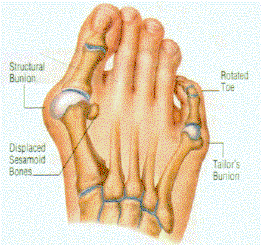
One of the more common conditions treated by podiatric surgeons is the painful bunion. Patients with this condition will usually complain of pain when wearing certain shoes, especially snug fitting dress shoes, or with physical activity, such as walking or running.
The most common symptoms associated with this condition are pain on the side of the foot. Shoes will typically aggravate bunions. Stiff leather shoes or shoes with a tapered toe box are the prime offenders. This is why bunion pain is most common in women whose shoes have a pointed toe box. The bunion site will often be slightly swollen and red from the constant rubbing and irritation of a shoe. Occasionally, corns can develop between the 1st and 2nd toe from the pressure the toes rubbing against each other. On rare occasions, the joint itself can be acutely inflamed from the development of a sac of fluid over the bunion called a bursa. This is designed to protect and cushion the bone. However, it can become acutely inflamed, a condition referred to as bursitis.
Bunions are most commonly treated by conservative means. This may involve shoe gear modification, padding and orthoses. When this fails to provide adequate relief, surgery is often recommended. There are several surgical procedures to correct bunions. Selection of the most appropriate procedure for each patient requires knowledge of the level of deformity, review of the x-rays and an open discussion of the goals of the surgical procedure. Almost all surgical procedures require cutting and repositioning the first metatarsal. In the case of mild to moderate bunion deformities the bone cut is most often performed at the neck of the metatarsal (near the joint).
Subscribe to:
Posts (Atom)
